Happy Accidents: Why the Moments Nobody Planned Are the Ones British Gig-Goers Live For
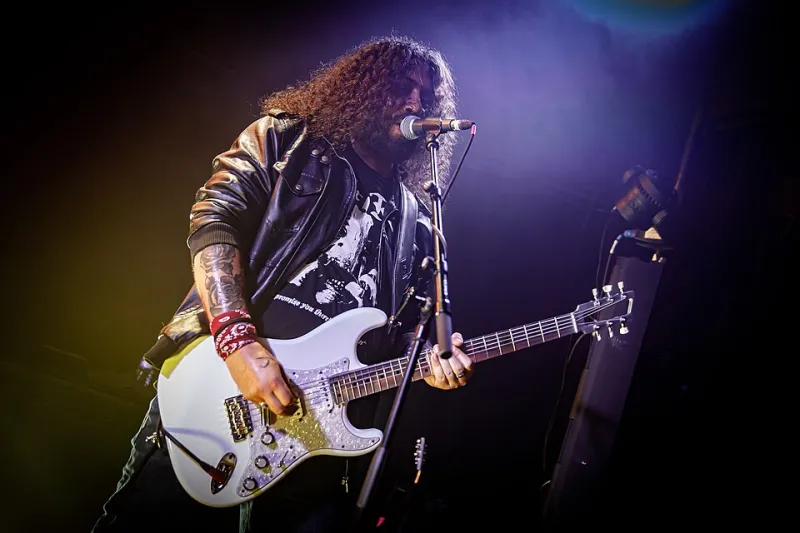
Photo: Dwidou Photography from Paris, France, CC BY-SA 4.0, via Wikimedia Commons
Here's a question worth sitting with. Think about the best live music experience you've ever had in Britain — the one you still bring up years later, the one that made you feel like you genuinely witnessed something. Now ask yourself honestly: was it the moment the artist executed the setlist perfectly, or was it something that happened in the gaps? Something unscripted. Something that felt, even briefly, like it might go wrong.
I'd put money on it being the second one.
There's a peculiar truth operating at the heart of British live music culture, and it's this: the moments audiences carry home are almost never the ones anyone planned.
The Planned Show vs The Real Show
Every professional performer arrives at a venue with a structure. A setlist. An idea of how the evening unfolds. This is sensible and necessary — performing without any framework is how you end up in a twenty-minute improvisational spiral that loses half your audience by the third song. The plan matters.
But the plan is also, in a very real sense, the floor rather than the ceiling. It's what happens when nothing exceptional occurs. The moments that exceed the plan — that break through its surface — are almost always the unscripted ones.
A string snaps mid-song, and the musician has to fill thirty seconds while a bandmate fetches a replacement. What they say in that thirty seconds — whether it's funny, honest, awkward, or all three — can define the entire night in the memory of everyone present. A guest who wasn't on the bill walks on from the wings. The crowd recognises them a half-second before the artist introduces them, and the room erupts in a way that a scheduled guest appearance simply never generates. The power cuts out for four seconds and comes back to find the whole room singing a capella, the band grinning at each other in the dark.
These things become stories. The perfectly executed show, technically speaking, often doesn't.
The Psychology of Surprise
There's a fairly straightforward psychological explanation for this, and it has to do with how memory actually works rather than how we imagine it does.
We don't record experiences like cameras. We reconstruct them, and the reconstruction process is heavily biased towards emotional intensity. Moments of surprise — genuine, unmanufactured surprise — generate a spike in emotional engagement that routine experience simply doesn't. When something unexpected happens, we're suddenly fully present in a way that comfortable predictability doesn't require us to be.
At a live gig, this plays out in interesting ways. The audience at a show is, to varying degrees, in a state of comfortable anticipation. They know roughly what to expect. They've heard the album, they've seen the setlists posted online, they know the artist's general style and approach. This familiarity is part of the pleasure — but it's also a kind of low-level detachment. You're enjoying something you've already partly imagined.
And then something happens that wasn't in the imagining. The artist does something genuinely unexpected. The room shifts. Everyone is suddenly paying a different quality of attention — sharper, more alert, more alive to what's actually happening in front of them rather than what they expected to see. That quality of attention is what turns an experience into a memory.
The British Audience Relationship
It's worth noting that this dynamic has a particular flavour in Britain, because British audiences have a particular relationship with their performers that's slightly different from the dynamic you find in other countries.
British crowds tend to be — and this is a generalisation, but a useful one — simultaneously warm and sceptical. They're not passive. They're assessing. There's a quality of watching and waiting that can feel intimidating to performers from elsewhere but is actually, when you understand it, a form of deep engagement. A British audience that's genuinely enjoying themselves is giving you something real, because they're not performing enjoyment for social reasons. They're actually feeling it.
This means that when something unscripted happens, the response is particularly genuine. The laughter at a disaster is real laughter. The collective gasp when something extraordinary occurs is a real gasp. The room doesn't perform its own reaction — it just reacts. And that authenticity feeds back into the performer in a way that can unlock something extraordinary.
The best British performers know this. They've learned to read that particular quality of attention, and they know when the room is alive to something unplanned and when to lean into it rather than scrambling back to the script.
The Accidental Guest and the Broken Setlist
Some of the most celebrated moments in British live music history are accidents or departures. The night a support act's equipment failed and the headliner invited them to share the stage and play acoustically. The show where the setlist was abandoned halfway through because the crowd's energy was taking the evening somewhere better. The impromptu encore that nobody had rehearsed, pulled off on instinct and collective musical knowledge.
These moments get talked about because they represent something that recorded music, by definition, cannot offer: genuine irreproducibility. You cannot stream what happened in that room on that night. You cannot recreate it. It existed once, briefly, and then it was gone. The people who were there carry a piece of it that nobody else has.
In an era when almost all recorded music is infinitely reproducible and immediately accessible, this kind of irreproducibility is genuinely precious. It's the thing live music offers that nothing else can match — and the most vivid examples of it are almost always the unplanned ones.
Making Space for the Accident
This isn't really an argument for performing badly or abandoning preparation. It's an argument for leaving room. For not over-engineering the experience to the point where there's no space for the unexpected to breathe.
The performers who generate the most memorable moments aren't the ones who've rehearsed every possible outcome — they're the ones who've developed the confidence and the musical instinct to respond to the room they're actually in rather than the room they imagined. Who can feel when the plan should be abandoned. Who trust themselves and their audience enough to let something happen that neither party can quite predict.
That's a skill. It takes time and experience and a particular kind of courage. But it's also, arguably, the most important skill a live performer can develop. Because the five-minute window that nobody planned — the accident, the departure, the thing that shouldn't have worked but absolutely did — is almost always the reason people come back.