Borrowed Songs, Original Souls: The Alchemy of Reinvention in British Music

The Ultimate Creative Gamble
There's a moment every British musician faces: standing in a rehearsal room, instruments ready, about to attempt someone else's song. It's terrifying. More terrifying, perhaps, than performing your own material, because you're not just risking failure—you're risking sacrilege.
Cover versions occupy a peculiar space in British music culture. We're simultaneously obsessed with them and suspicious of them. We celebrate artists who dare to reimagine classics, yet we're ruthlessly critical when they get it wrong. It's a creative tightrope walk where the stakes couldn't be higher.
The Art of Musical Translation
When Johnny Cash recorded 'Hurt,' he didn't just sing Trent Reznor's words—he translated them through decades of experience, heartbreak, and hard-won wisdom. The song became something entirely different while remaining fundamentally the same. That's the alchemy every cover version attempts, and it's why most fail.
British artists have always understood this challenge differently than their American counterparts. Where American covers often aim to match or exceed the original's energy, British interpretations tend toward deconstruction. Think of The White Stripes' 'Jolene' becoming a garage rock anthem, or Jeff Buckley's ethereal take on 'Hallelujah'—though Buckley was American, his approach felt distinctly British in its willingness to completely reimagine the song's emotional landscape.
Consider how differently British artists approach the same source material. When both Sinéad O'Connor and Chris Cornell covered 'Nothing Compares 2 U,' they found entirely different emotional territories within Prince's composition. O'Connor's version became a raw confession of loss, while Cornell's transformed it into a grunge meditation on isolation.
The Courage to Destroy
The best cover versions require a kind of creative vandalism. You have to be willing to tear down what everyone loves about the original and rebuild it in your own image. This takes extraordinary confidence—or perhaps extraordinary naivety.
I remember watching a young band at Liverpool's Cavern Club attempt The Beatles' 'While My Guitar Gently Weeps.' The irony wasn't lost on anyone—covering The Beatles in the venue where they cut their teeth. But instead of trying to match George Harrison's delicate melancholy, they stripped it down to its bones: just vocals and a single acoustic guitar. The result was devastating in its simplicity, more intimate and immediate than the studio version ever managed.
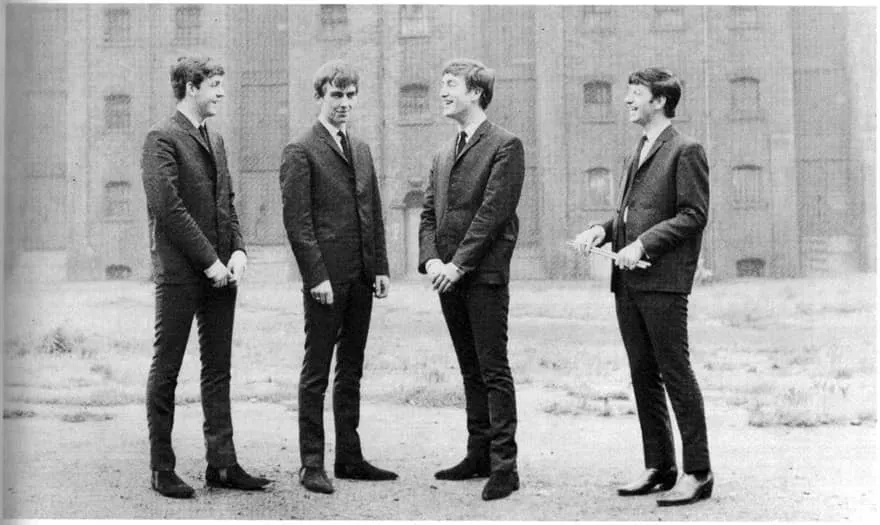 Photo: The Beatles, via www.beatlesbible.com
 Photo: Liverpool's Cavern Club, via seethebigworld.com
This willingness to destroy and rebuild is perhaps uniquely British. We've always been a nation of musical magpies, borrowing from blues, reggae, punk, and electronic music to create something distinctly our own. Our greatest artists—from The Rolling Stones to Amy Winehouse—have been master interpreters as much as original composers.
The Weight of Expectation
Every cover version carries the weight of collective memory. When Radiohead plays 'The Headmaster Ritual' or when Arctic Monkeys tackle 'Love Is a Laserquest,' they're not just performing songs—they're engaging with cultural artifacts that live in millions of people's personal soundtracks.
This creates a unique pressure. The audience arrives with preconceptions, emotional attachments, and often, fierce protective instincts. I've seen crowds turn hostile when an artist's interpretation strayed too far from their cherished memories. But I've also witnessed magical moments when a reinterpretation illuminated aspects of a familiar song that no one had noticed before.
The key lies in understanding what made the original powerful and then finding your own path to that same emotional destination. It's not about copying the surface elements—the guitar tone, the vocal delivery, the arrangement—but about capturing the song's essential truth and expressing it through your own musical DNA.
Masters of Reinvention
Some British artists have made careers from inspired reinterpretation. Take PJ Harvey's approach to covering—whether she's tackling Bob Dylan or traditional folk songs, she filters everything through her distinctive artistic vision. Her covers don't sound like PJ Harvey trying to be someone else; they sound like other artists' songs being absorbed into the PJ Harvey universe.
 Photo: PJ Harvey, via imgcdn.stablediffusionweb.com
Similarly, when Massive Attack covered 'Light My Fire' on their Protection album, they didn't attempt to recreate The Doors' psychedelic energy. Instead, they reimagined it as a piece of trip-hop sculpture, all space and atmosphere and subliminal groove. The result bore almost no surface resemblance to the original, yet somehow captured its essence more completely than any straightforward rock interpretation could have.
The Revelation Factor
The greatest cover versions don't just reinterpret songs—they reveal hidden depths that were always there. When Feist covered The Bee Gees' 'Inside and Out,' she uncovered a melancholy that the disco arrangement had masked. When The National took on Sufjan Stevens' 'Terrible Love,' they found a different kind of desperation within the same lyrical framework.
This revelation factor is what separates transformative covers from mere tributes. It requires not just technical skill but genuine empathy—the ability to hear what a song is really about beneath its original presentation and then find new ways to express that truth.
The Modern Challenge
In our digital age, cover versions face new challenges. YouTube is flooded with bedroom interpretations of everything from chart hits to deep cuts. The sheer volume makes it harder for truly inspired reinterpretations to find their audience. Yet it's also democratised the art form, allowing artists to experiment with covers as a way of developing their own voice.
Many of Britain's most exciting emerging artists use covers as creative workshops. They'll strip down a Beyoncé track to discover its harmonic structure, or reimagine a hip-hop hit as a folk ballad to understand how melody and rhythm interact. These exercises often reveal more about an artist's potential than their original compositions.
The Eternal Question
Ultimately, every cover version asks the same question: what happens when one creative vision encounters another? The answer reveals everything about both the interpreter and the interpreted. When it works, it's like watching two artists collaborate across time and space, creating something neither could have achieved alone.
The next time you hear an artist attempting someone else's song, listen not for how closely they match the original, but for how completely they make it their own. Because in the end, the best covers don't just borrow songs—they steal souls and give them new bodies to inhabit.