Opening Night Nerves: The Brutal, Beautiful Truth About Playing Support in Britain
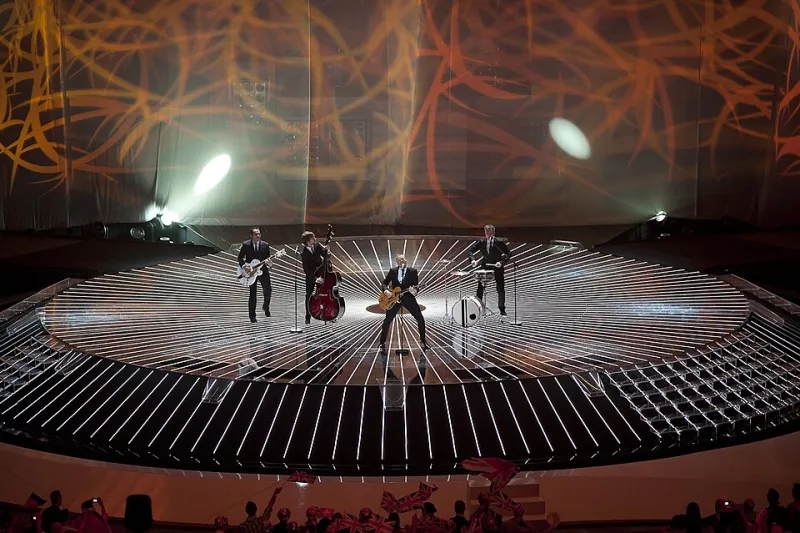
Photo: Frédéric de Villamil from Paris, France, CC BY-SA 2.0, via Wikimedia Commons
Every musician who's ever played a support slot has a story. Some of those stories involve a crowd going absolutely wild for an act nobody had heard of forty minutes earlier. Some involve performing an entire set to a venue that was, at the time, roughly 70% empty and 30% disinterested. Most involve a complicated mixture of both, plus a soundcheck that ran fifteen minutes over and a dressing room the size of a broom cupboard.
The support slot is one of British live music's most peculiar institutions. It's positioned as an opportunity — and genuinely, it can be — but it comes loaded with unspoken rules, structural disadvantages, and an emotional complexity that nobody quite prepares you for.
The Promise and the Problem
Let's start with what a support slot actually offers on paper. You get access to a larger audience than you'd typically draw on your own. You get a proper PA system, a decent stage, and the implicit endorsement of being associated with a more established act. For a developing artist, that's a meaningful platform.
The problem is that the audience hasn't come to see you. They know this. You know this. And navigating that shared awareness is one of the more psychologically demanding things a performer can face.
There's a specific kind of indifference that a support act crowd can project — not hostile, just absent. People are still arriving, finding their friends, getting their first drink, catching up on the conversation they started in the car park. The show, from their perspective, hasn't started yet. You are, functionally, ambient noise until proven otherwise.
That's the challenge. And it's a significant one.
The Unwritten Rules
Anyone who's spent time in the touring ecosystem will tell you there's an entire code of conduct around support slots that nobody officially writes down but everyone's expected to know.
First rule: don't run over your allotted time. Not by a minute. The headline act's crew have a schedule, and the goodwill you might generate by playing an extra song gets immediately cancelled out by the logistical headache you've caused backstage. If you've been given thirty minutes, play twenty-eight and get off.
Second rule: the headliner's backline is not your backline. Unless you've been explicitly told otherwise, you don't touch the gear. You don't adjust the headline act's monitor mix. You work with what you've been given, and you're grateful for it.
Third rule — and this one's more nuanced — read the room and adapt. Your job isn't to play your favourite set. Your job is to warm up a crowd for someone else. Those are genuinely different briefs, and the support acts who understand that distinction are the ones who tend to get asked back.
When It Goes Right
The stories of support slots that changed everything are real, and they're worth holding onto.
British music history is littered with examples of acts who stepped onto a stage as a relative unknown and walked off with half the headline act's fanbase. It happens when the chemistry is right — when the support act's sound is adjacent enough to the headliner's audience to resonate, when the performance is sharp enough to cut through the pre-show chatter, when something clicks in that slightly improbable way that live music occasionally allows.
When a support set lands, it lands hard. There's something uniquely powerful about winning over a crowd that wasn't expecting to care about you. The energy in the room shifts in a way that's almost physical. People who were half-watching suddenly put their phones away. That's not a small thing.
For the artist, that experience is transformative. Not just commercially — though a well-placed support slot can genuinely accelerate a career — but creatively. Learning to hold a room that isn't already on your side is one of the most demanding performance skills there is. The support circuit is where a lot of British artists develop the kind of stage presence that carries them through the rest of their careers.
When It Doesn't
Equally real are the nights that go the other way.
Sometimes the mismatch between support and headliner is just too pronounced. Genre clashes that look fine on paper can feel jarring in practice. A crowd who've come for a specific type of music can be genuinely unreceptive to something they weren't expecting, and no amount of performance quality changes that fundamental disconnect.
There's also the venue factor. A support slot in a half-empty room — because the early arrivals are still trickling in — can feel profoundly demoralising, even when you're playing well. Standing on a stage delivering your best work to people who are looking at the door waiting for their mates is a particular kind of deflating.
The artists who survive these nights intact tend to have developed a very specific mental compartmentalisation. They separate the quality of the performance from the quality of the reception. They understand that a poor crowd response is often a structural issue rather than a personal one. That's easier said than done, especially early in a career.
What the Headliners Owe
It's worth acknowledging that this dynamic isn't entirely one-directional. Headline acts have responsibilities in this relationship too, and not all of them honour those responsibilities particularly well.
The best headliners actively champion their support acts — mentioning them from the stage, making sure they've got what they need backstage, treating them like collaborators rather than furniture. That kind of generosity costs nothing and means an enormous amount to an act that's still finding its feet.
The worst headliners are simply indifferent, which creates a backstage atmosphere that can undermine a support act's confidence before they've even played a note. The music industry is small enough that these reputations travel.
The Long Game
For all its complications, the support slot remains one of the most important rungs on the ladder of British live music. The artists who approach it strategically — choosing the right opportunities, learning from the difficult nights, building relationships rather than just ticking a box — tend to come out of the experience measurably stronger.
The key is understanding what you're actually there to do. You're not there to steal the show. You're there to be good enough that people remember your name when you come back to headline your own night. That's the quiet, unglamorous ambition of the support slot. And when it works, it really works.